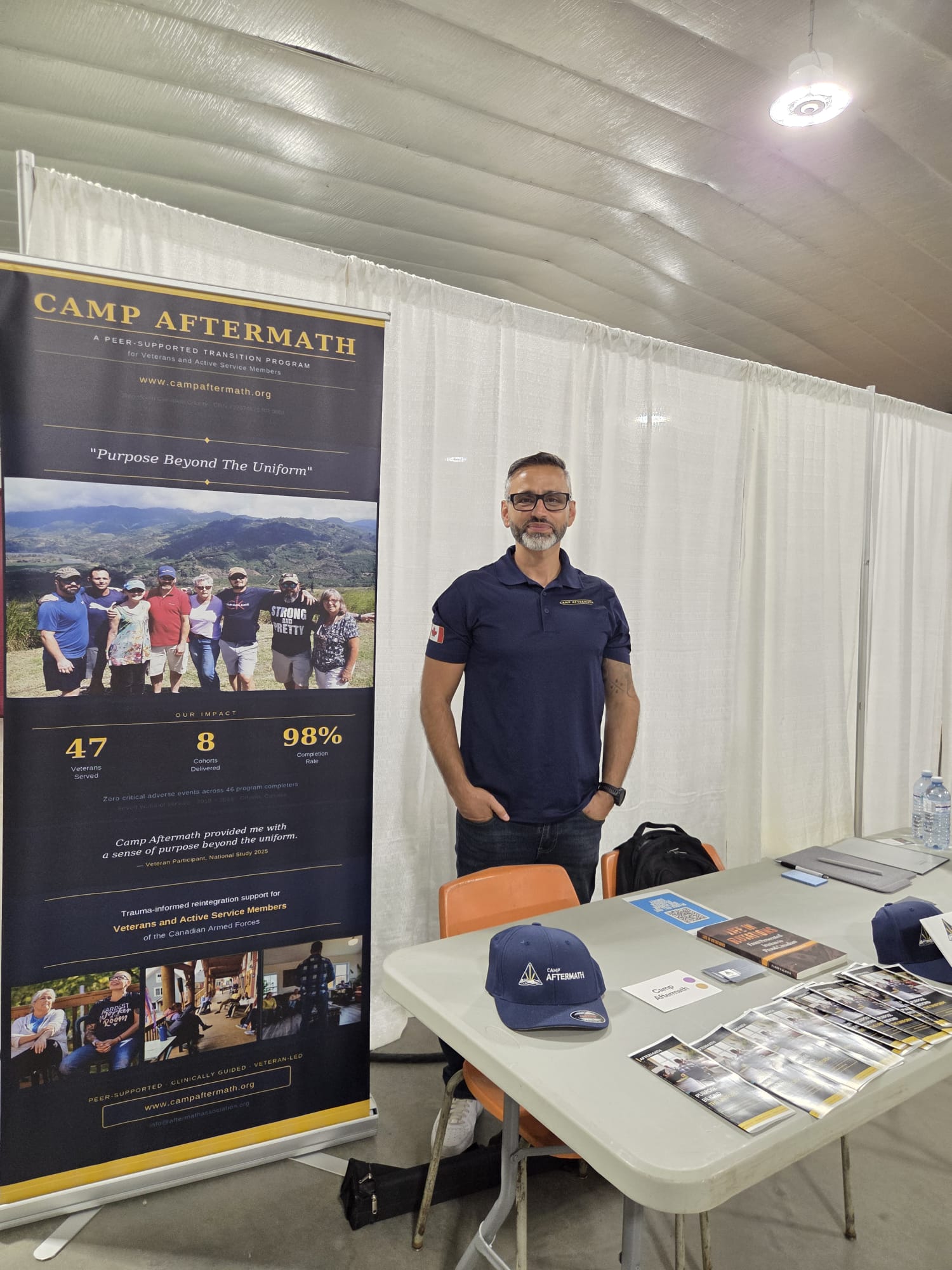
I spent September 16 standing beside the Camp Aftermath booth at the Petawawa Civic Centre, surrounded by tables representing almost every part of the system built to support Canadian Armed Forces members, Veterans and their families. Career Connections 2026, hosted by the Petawawa Military Family Resource Centre with the CAF Transition Unit and the Renfrew County Community Futures Development Corporation, brought transition professionals, employers and service organizations together from 11 a.m. to 5 p.m. It was a good day to think about Veteran transition in Canada and how far it has come.
Years ago, an event with this much breadth would have been hard to imagine. Camp Aftermath was grateful just to be invited to have a booth.
But a question followed me home. What about the person inside the uniform?
Seeing How Far Veteran Transition Support Has Come
Throughout the day I was in conversation with people from the CAF Transition Unit, the Petawawa Military Family Resource Centre and other stakeholders, such as Veterans Affairs Canada. We talked about how Camp Aftermath might be better understood by transition staff, about the realities Veterans can face even when nothing looks like a crisis, and about where an organization like ours fits inside a much larger ecosystem of care.
None of these conversations represent an endorsement of Camp Aftermath, and I would not want them read that way. Camp Aftermath does not want to compete with any of these organizations. We want to be a good neighbour to them.
Then We Started Listening to Veterans
One Veteran, moving through a medical release, told me he was scared, and that the process felt like it was moving quickly. He was surrounded by services and people trying to help, and still felt personally uncertain about what came next. That gap between administrative preparedness and personal readiness is not a criticism of anyone. It is simply something worth paying attention to.
Other conversations echoed a similar pattern in different forms. One Veteran had stayed extremely busy since leaving, volunteering heavily and taking on responsibility after responsibility until he was spread thin. Transition is not necessarily solved by handing someone another mission. Sometimes what a person needs is space to build an identity where contribution, family, relationships, health and purpose can all exist together, instead of one mission consuming everything else.
Another had gone through a period of real isolation after leaving the military, and discovered blacksmithing almost by accident. What started as a distraction slowly became a craft, then a business, then a place where other Veterans started showing up. It became a form of mastery, connection and belonging, built one piece at a time.
These conversations were not a research study, and we would never treat them as one. But they reinforced a question that has shaped Camp Aftermath from the beginning. What happens after the practical pieces of transition are underway, but the person is still trying to understand who they are without the uniform?
Leaving the Military and Becoming Someone After It Are Different Processes
Employment, benefits, housing, health care and family support all matter, and the organizations working on these pieces are doing essential work. But alongside all of that sits a quieter question. Not what do I do next, but who am I becoming?
Transition is not only about helping a soldier leave the military. It is also about helping the person inside the uniform build a life beyond it.
The system is increasingly good at the first part. The opportunity now, as we heard it, is to keep strengthening how we support the second.
From Transition to Flourishing
A theme came up again and again in conversations that day, across several organizations. The goal of transition should not stop at getting through release. It should extend toward building a meaningful life afterward, something closer to flourishing than simply coping.
That framing resonated with me. I am not suggesting any one organization’s language should be read as an endorsement of Camp Aftermath, or that Veterans Affairs Canada has adopted new official terminology. I am saying that hearing this idea surface in conversation after conversation gave me confidence that we are not the only ones asking it.
Why Petawawa Reaffirmed Our Purpose
Camp Aftermath is a Veteran-led, peer-supported, clinically guided reintegration program, approximately one year long and free of charge. It exists alongside, not instead of, the services and professionals a Veteran already has in their life. You can read more about how the program works here.
We are not interested in offering Veterans another mission to replace the one they left. A healthy identity after service should be bigger than that. The question we keep coming back to is simple. Who are you becoming now?
September 16 did not prove that Camp Aftermath’s model works. One day at one event cannot do that. What it did was reaffirm why we keep asking these questions, and why evidence, evaluation and partnership across this ecosystem matter as we grow.
None of this happens without the Petawawa Military Family Resource Centre, who hosted Career Connections 2026 and did the work of bringing so much of this ecosystem into one room. Thank you as well to the CAF Transition Unit and the Renfrew County Community Futures Development Corporation for organizing alongside them, to Veterans Affairs Canada and every organization we connected with in the room that day, and most of all to the Veterans and transitioning members who shared pieces of their stories with a stranger at a booth.
The uniform may be part of a Veteran’s story forever. It does not have to be the final chapter.
Learn more about Camp Aftermath’s Veteran reintegration program.